How to read an old house: find out what is original, what has been added since, and what the traces tell you, before anyone decides anything. An old house is built in layers, and every layer has a reason. Once you know them, the next change can answer the house instead of erasing it.
That is how we begin every project. And it is the first article in a series on the traditional crafts that have kept Danish houses standing for more than a hundred years.
What is the point of reading a house?
The point is to know the house's history and its condition, not to take it back to how it once looked. That is how the Danish Agency for Culture and Palaces puts it in its guidance on building history: the survey should show what is original, what has been added and what works, so that a project can respect what is worth keeping.
The difference matters. A house from the 1920s may have had new windows in the 1950s and an extension in the 1970s. Some of those changes are good and now belong to the house. Others work against it. You can only tell once you have read them.
Where do you start?
You start in the archive. The municipality's building records often hold the drawings the house was built from, and the drawings for later alterations. Many municipalities have put their records online, at weblager.dk or filarkiv.dk. If yours is not there, you can ask the municipality for the papers.
Two more look-ups belong to the first step:
- Is the house listed, or of preservation value? The Agency for Culture and Palaces keeps a public register of listed and preservation-worthy buildings at kulturarv.dk.
- What does the local plan say? The local plan in force is published at plandata.dk. It can set rules for facades, roofs and windows.
The archive tells you what was planned. The house tells you what was actually built.
What can you see in the house itself?
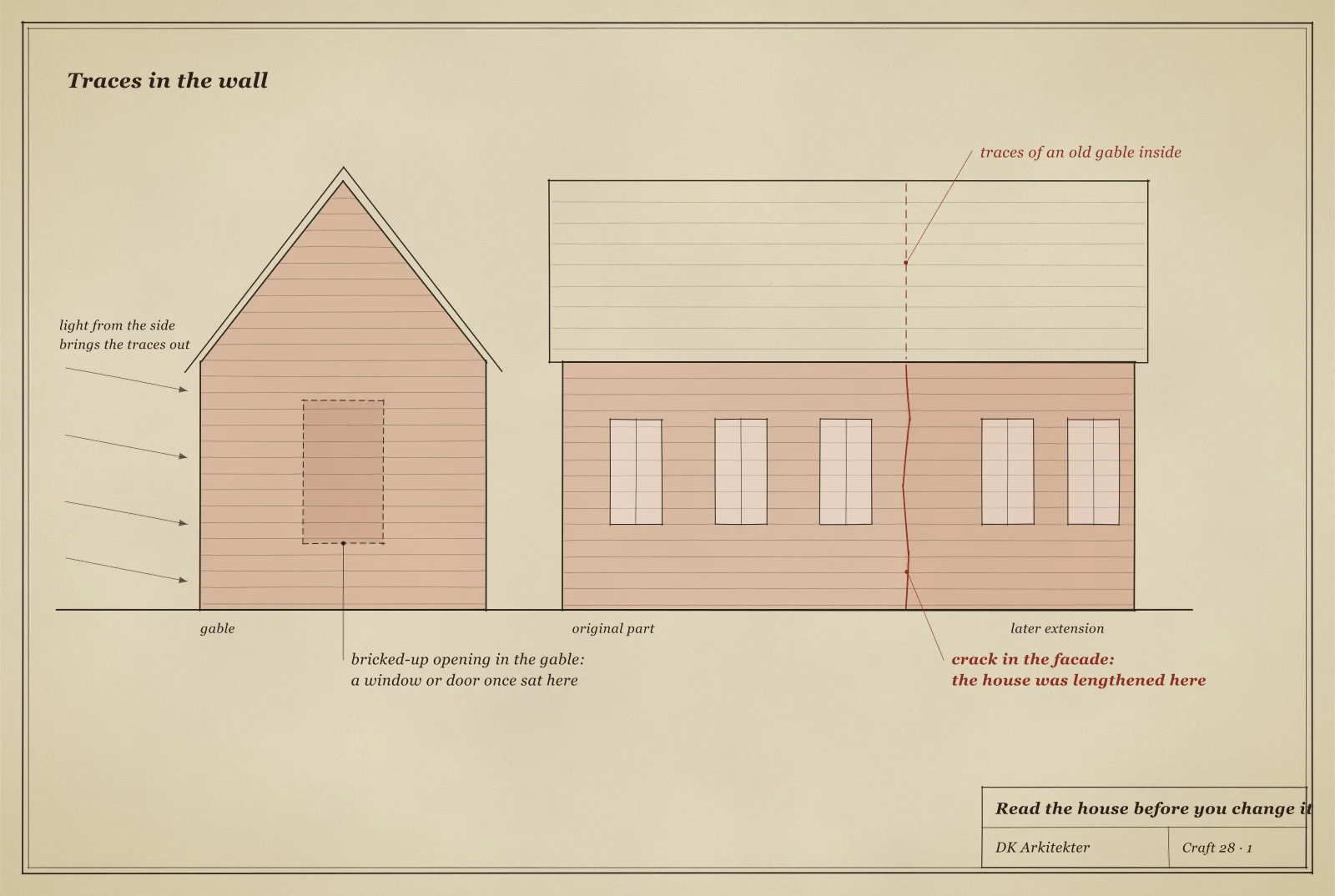
You can see more than you expect if you look systematically. A bricked-up opening in a gable shows where a window or a door once was. A crack in the facade, read together with the trace of an old gable inside, can show that the house has been lengthened. Light from the side brings the traces out in a wall or a ceiling.
Even the small things date a house. According to the Agency for Culture and Palaces, machine-made bricks, roof tiles, windows, doors and nails reached Denmark around 1860–70, and machine-drawn window glass around 1920. A hand-forged window hinge looks different from a machine-made one. Details like these show which parts of the house are original.
When the sources disagree, the traces in the building count most. A painting or a drawing may show one colour. The paint layers on the facade show what was actually there.
What is a paint investigation?
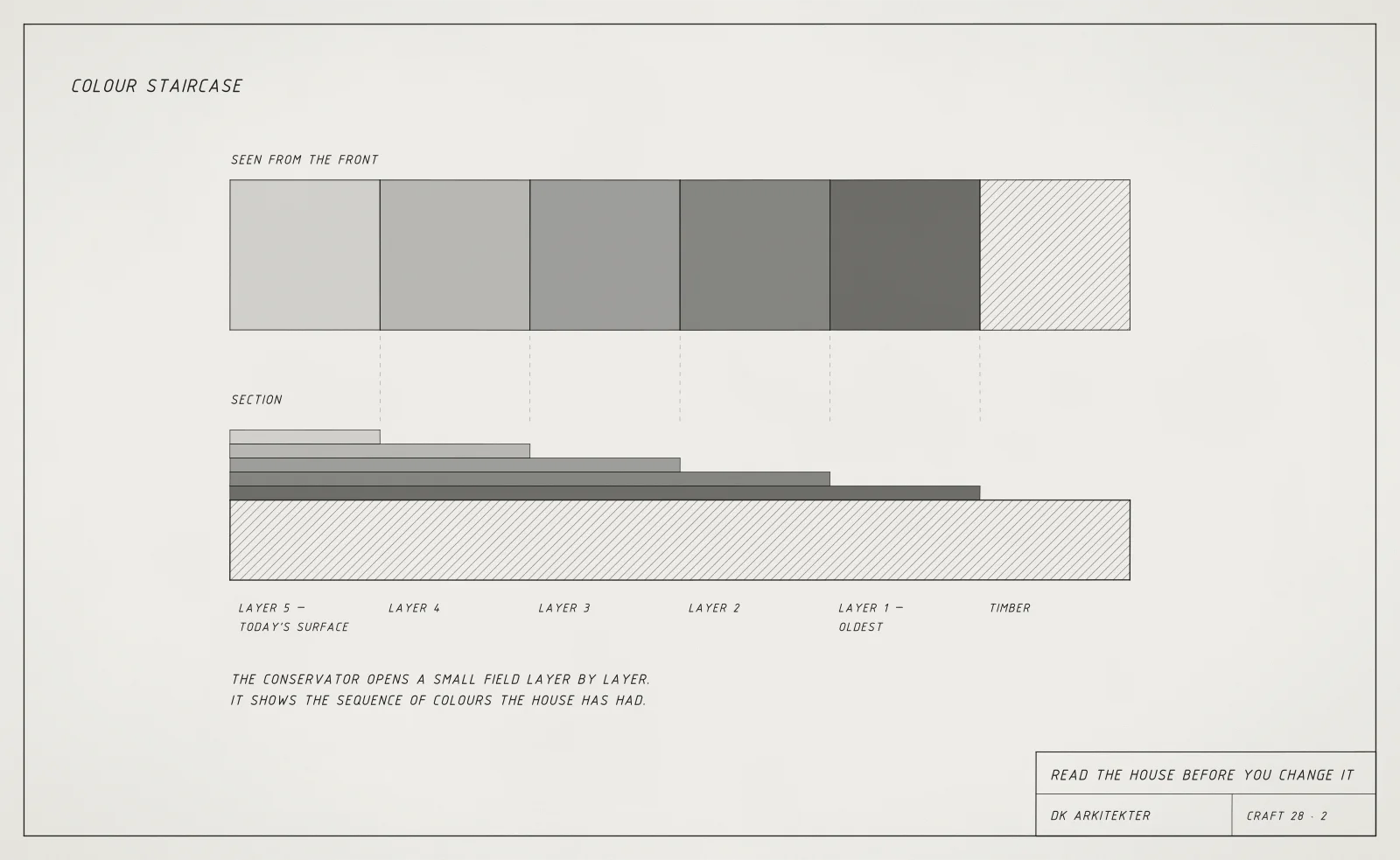
A paint investigation is a study of the paint layers beneath a house's present surfaces, carried out by a conservator. The conservator opens small patches layer by layer, so you can see the sequence of colours the house has had. The layers cannot be dated precisely from the colour alone, so it is the conservator's job to judge which layers were visible at the same time on the different parts of the building.
The result is not an order to paint the house as it was. It is a basis for choosing colours that belong to it.
Do you have to remove anything to see?
No. You start with what destroys nothing. Measuring, photographing and small, local uncoverings tell you most of what you need. The Agency for Culture and Palaces warns against stripping later layers in the hunt for the oldest ones. If something does have to come off, photograph and measure it first, and keep the parts that are taken down.
Old wallpaper is a good example. Before it is stripped, you can cut out a sample the size of a sheet of paper with every layer in it. The history is kept, even when the wall is new.
What do you get out of it?
You get a basis for deciding. You know which parts of the house are worth keeping, which can be changed freely, and where the house has failed and why. It saves money, because you do not replace what could have been repaired. And it makes a better house, because the new work fits the old.
It is also how we work in our heritage studies: we read a building's archive and the building itself before we write about it. The next articles in this series look closely at the individual crafts, starting with repointing brickwork and the choice between lime and cement mortar.
See it done — Film from Byggefilm.dkBuilding archaeology (in Danish)Film: Byggefilm.dk / Chroma Film ApSOpen the film ↗See it done — Film from Byggefilm.dkPaint investigation by a conservator (in Danish)Film: Byggefilm.dk / Chroma Film ApSOpen the film ↗Shall we look at your house?
The first reading of your house can begin with our free property report. It tells you what the local plan and any listing say about your property, and it needs no visit. If you are facing a larger renovation, you can read how we approach a full renovation or a historic property.