Lime mortar is the mortar most old Danish houses were laid and pointed with. Lime mortar is softer than the bricks around it, and that is the point. It takes the moisture and the movement, and it can be renewed without harming the bricks.
That is why the choice between lime mortar and cement mortar is one of the most important choices when an old wall is repaired.
What is lime mortar?
Lime mortar is a mix of slaked lime and sand. It hardens slowly by taking carbon dioxide from the air, so the lime turns back into limestone. It has been used in Denmark since the Middle Ages, for laying bricks, for pointing and for render.
There are two main kinds. Air lime mortar hardens with the air alone. Hydraulic lime mortar also hardens with water, and is somewhat stronger and better at resisting water. According to the Danish Agency for Culture and Palaces, analyses show that almost all historic mortars in Denmark were hydraulic to some degree.
When did cement arrive?
Portland cement reached Denmark in the second half of the 1800s. The first Danish works opened in 1868. With cement came lime-cement mortar, a mix of lime, cement and sand, which is harder and stronger than pure lime mortar. Today lime-cement mortar is the mortar used in new brickwork.
Why is lime better for an old wall?
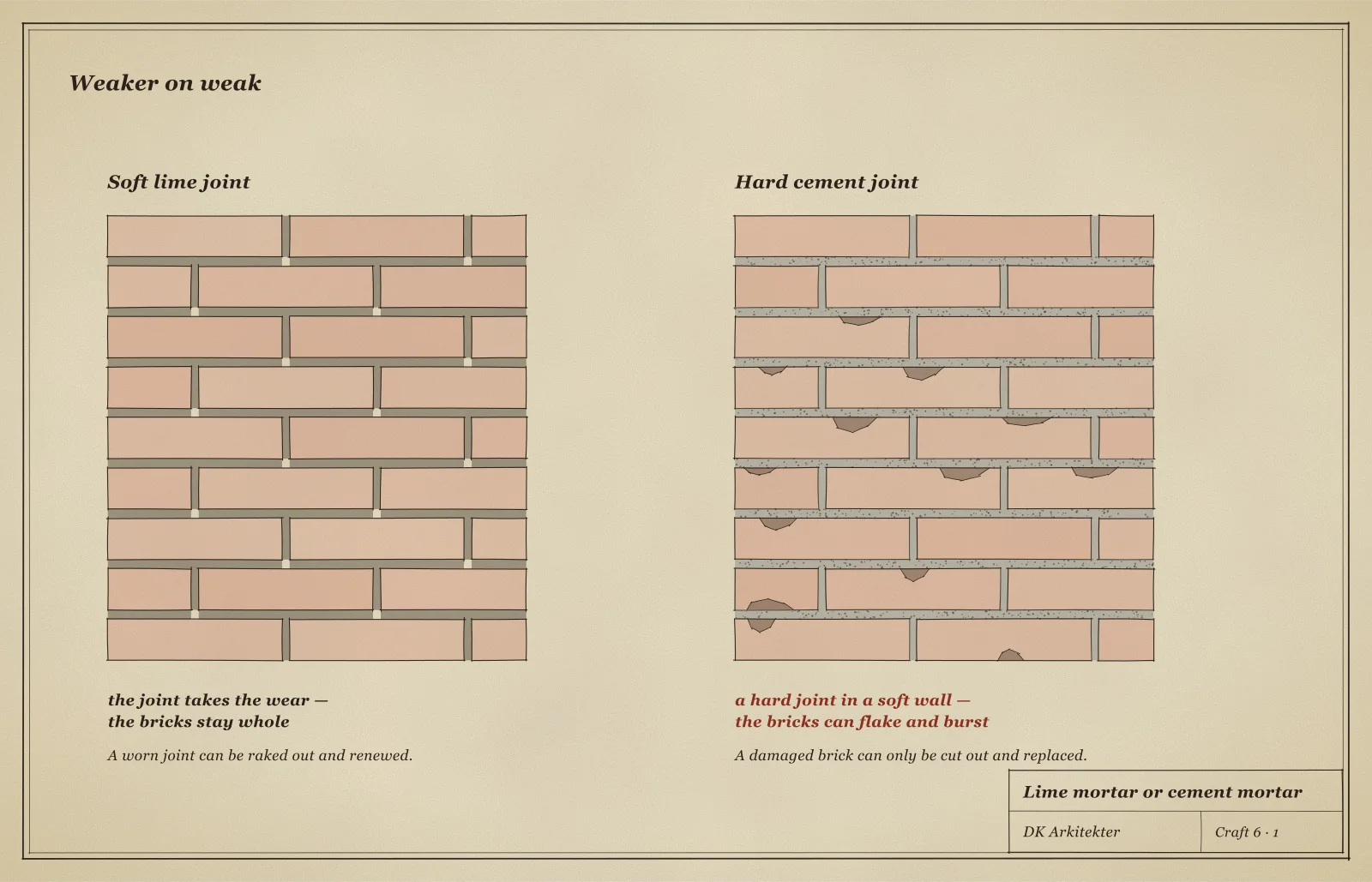
Because a mortar should be weaker than the bricks it sits between. The Agency for Culture and Palaces calls the principle weaker on weak, never strong on weak. A soft mortar takes the wear, the moisture and the small movements, so the bricks do not have to. When the joint is worn at last, it can be raked out and renewed.
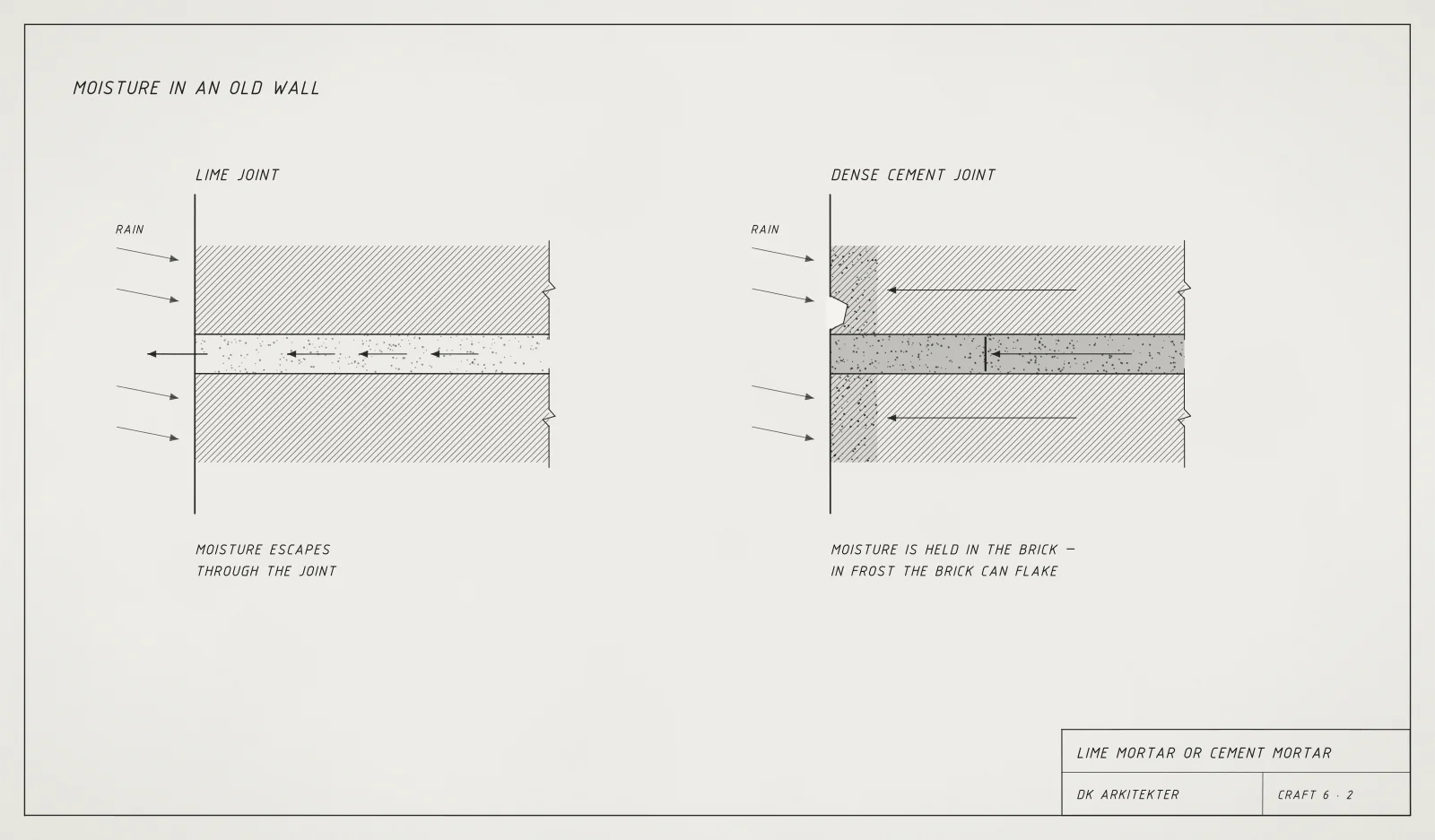
Lime mortar also lets moisture out. According to the Agency, pure lime mortars give up water faster than mortars with cement. An old wall is used to getting wet and drying out again. It needs to go on doing so.
What happens if cement is used?
Then the bricks can pay for it. A hard, dense joint in a soft wall holds the moisture in, and bricks that cannot get rid of moisture can flake or split in frost. A municipal guide to older houses warns that new, strong joints often come loose, because they do not take up and give off moisture the way the wall's old lime mortar does. Bolius, the Danish homeowners' knowledge centre, warns in the same way: a mortar much stronger than the existing one raises the risk of the joint flaking off.
There are exceptions. In especially exposed places, such as chimneys, roof ridges and plinths, the Agency recommends a mortar with some cement in it, even on houses otherwise laid in lime. And houses built from hard-fired, machine-made bricks may have been laid in lime-cement mortar from the start. Then that is the mortar to point with.
How can you tell if a wall was laid in lime?
There are two quick signs. Bolius' expert suggests scraping the joint with a pointing tool: if the mortar comes out without sticking to the brick, it is lime mortar. The colour says something too. Grey joints usually contain cement, while beige joints contain little or none.
If the house is listed or especially valuable, have the mortar analysed. The Agency for Culture and Palaces often works with test panels, where the new joint is tried on a small piece of wall before the whole facade is pointed.
What is the mixing ratio for lime mortar?
There is no single ratio that suits every wall. A lime mortar is written as parts lime to parts sand, and a hydraulic mortar as parts air lime, parts hydraulic lime and parts sand. The right recipe for your wall is chosen from the old mortar: its strength, its sand and its colour. The Agency for Culture and Palaces' guidance sheet on mortar and render gives the recipes for the different tasks.
The sand matters more than you might think. Its grain size and colour decide how the mortar looks and part of how it behaves. That is why, on listed buildings, the Agency often requires the joint to be made with the same kind of sand as the original. Ready-mixed mortar from a builders' merchant is, according to Bolius, often too strong and too light in colour for an old house.
When can you work with lime mortar?
In the frost-free part of the year, and not below 5 °C. Below 5 °C the hardening stops, and below freezing the mortar can be damaged. Too much heat and direct sun are harmful too, because the mortar dries before it has hardened. The wall is wetted before pointing or rendering.
Nor does lime mortar need improving. The Agency advises against mixing additives into it. The material has been used for more than 2,000 years as it is.
What does it mean for your house?
Before anyone points or renders an old wall, you need to know what the wall was built with. That is part of reading the house before you change it. The work on the joints themselves is in our article on repointing brickwork.
See it done — Film from Byggefilm.dkLime mortar (in Danish)Film: Byggefilm.dk / Chroma Film ApSOpen the film ↗See it done — Film from Byggefilm.dkJoints (in Danish)Film: Byggefilm.dk / Chroma Film ApSOpen the film ↗Shall we look at your house?
The choice of mortar is a small decision with a large effect, and it belongs in a wider plan for the house. Read how we approach a full renovation or a historic property, or begin with our free property report. It needs no visit.