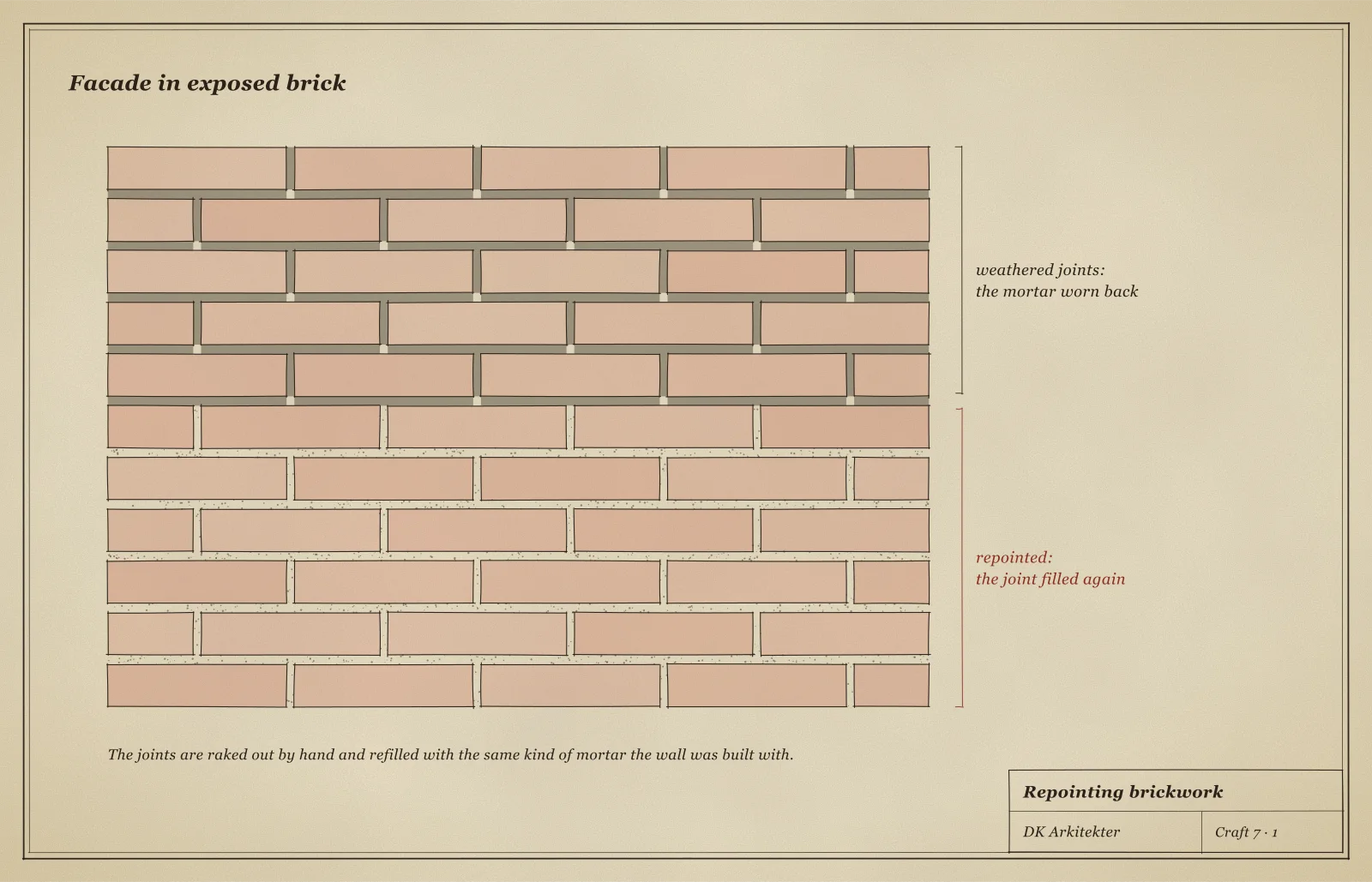
Repointing brickwork means raking out the worn joints and filling them with new mortar. The joints are the part of a wall made to be renewed, so that the bricks can stay. Done the old way, repointing keeps the wall tight and leaves the bricks alone for many years.
Here is what a homeowner should know before anyone starts.
Why do the joints matter so much?
The joints bind the bricks together, and they keep the water out. They are part of the wall's structure, not only of its looks. That is why a new joint should match the old one in both mortar and shape. The Danish Agency for Culture and Palaces says it plainly: use the same type of mortar as the original, because the joint matters for the building's whole appearance and for its structure.
The joints also take the wear and the weather, so the bricks do not have to. It is a good arrangement. Joints can be renewed. A brick that has split can only be replaced.
When does a wall need repointing?
A wall needs repointing when its joints have weathered away. Bolius, the Danish homeowners' knowledge centre, lists the usual signs:
- joints that crumble, or are wholly or partly gone
- holes in the joints, for example from masonry bees
- cracks in joints or bricks, especially stepped cracks and cracks above windows and doors
- bricks split by frost
Wide cracks, or cracks that grow, can be a sign of settlement. A professional should look at those before any pointing is done.
Small areas can be repaired on their own. If the joints are worn across the whole facade, or the colour has to be even everywhere, it is the whole facade that needs repointing.
How deep should the joints be raked out?
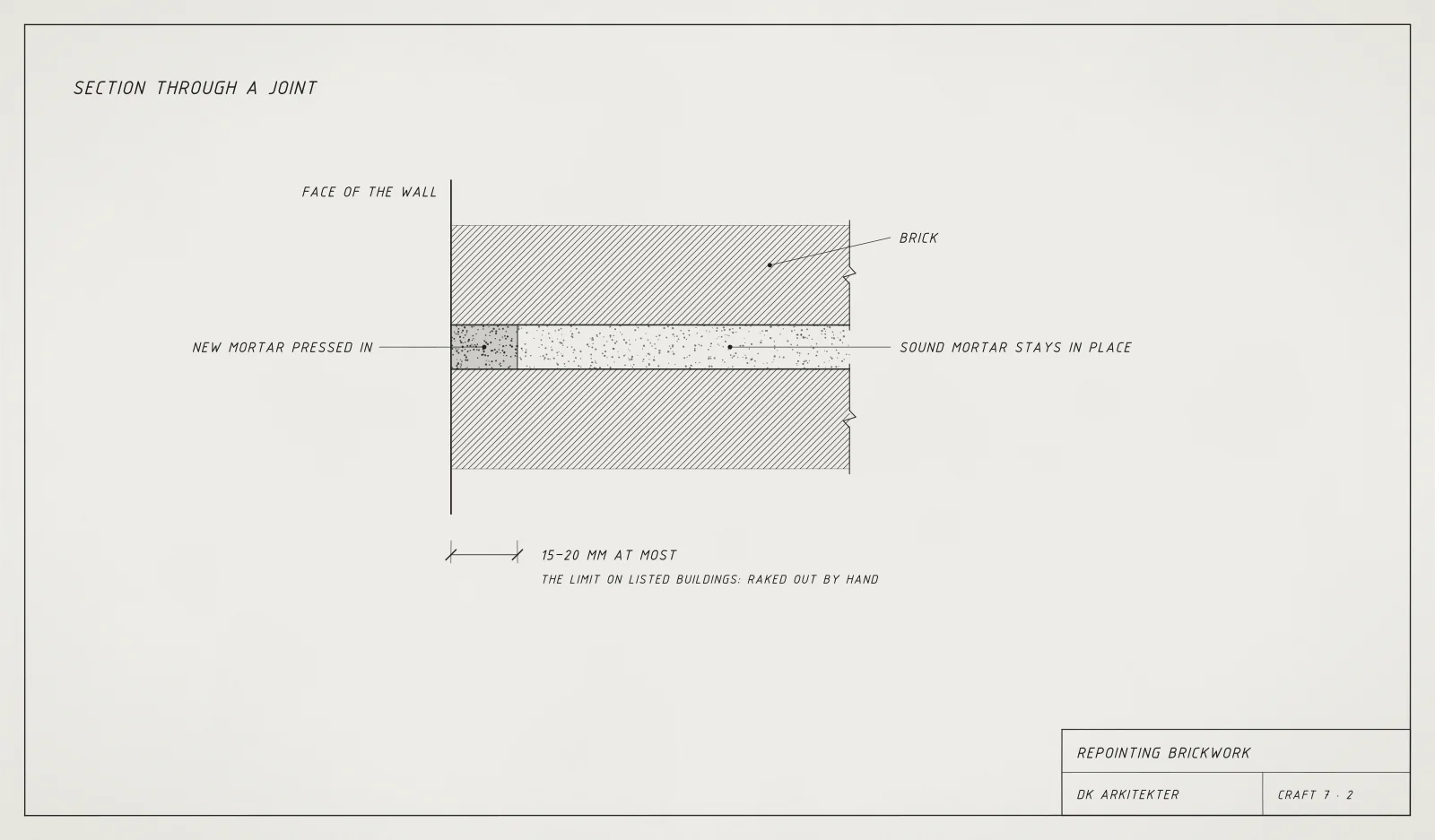
Usually 1.5–2 cm. Bolius recommends raking back to sound mortar, at least 13 mm from the face of the finished joint and 25 mm where there are holes. On a listed building the Agency for Culture and Palaces sets a limit: the joints are raked out by hand to no more than 15–20 mm, so the joint ends up 1.5–2 cm behind the face of the wall.
How the joints are raked out matters just as much. A joint-cutting machine is fast, but on old, soft bricks it easily bites into the edges of the bricks and widens the joint. On listed buildings the Agency therefore normally requires the joints to be raked out by hand. Machines are allowed only in special cases, and after a test panel.
Which mortar should be used?
The same kind of mortar the wall was built with, and never a stronger one. Bolius warns that a mortar much stronger than the existing one raises the risk of the joint flaking off. The Agency for Culture and Palaces calls the principle weaker on weak, never strong on weak.
In an older house that is often a lime mortar. Why it matters, and how to find out what your wall was laid in, is in our article on lime mortar and cement mortar.
Bolius gives a useful clue: grey joints usually contain cement. Beige joints usually contain little or none. Ready-mixed mortar from a builders' merchant is often too strong and too light in colour for an old house.
When in the year should you repoint?
In the frost-free part of the year, and not below 5 °C. The mortar has to harden before it can take frost, and below 5 °C the process stops. Both the Agency for Culture and Palaces and the makers of lime mortar say so.
Heat and sun are the other danger. A joint that dries too fast cracks. So pointing is not done in direct sun, and the wall is wetted first, so the bricks do not draw the water out of the fresh mortar.
What about bricks that need replacing?
A brick that has split in the frost or crumbled is cut out and replaced. The new brick should match the old one in quality, colour and surface. That is the Agency's requirement on listed buildings, and it is a good rule on any old house. Reclaimed bricks from the same period are often the best choice.
Old hand-made bricks are not all the same length. The bricklayer took up the difference in the joint, and that is part of why a hand-made wall looks alive. We wrote about it in the chapter Brick, sorted by hand in our study of Copenhagen City Hall. The same study records that the City Hall tower has been repointed twice since the 1970s. Even the best wall needs new joints in time.
What does repointing cost?
It depends on the wall. The price is set by the area to be pointed, whether scaffolding is needed, how hard the wall is to reach, how deep and how carefully the joints have to be raked out, how many bricks need replacing, and whether the old mortar has to be analysed first. Ask for the work to be described before you compare prices. Two quotes for "repointing" can cover very different jobs.
Should you ask the municipality first?
If the house is listed, repointing normally needs permission from the Agency for Culture and Palaces, which will want the method and the mortar type described. If the house is of preservation value, or lies in a local plan with rules for facades, read the plan before changing the colour or the shape of the joints. How to find both is in our article on reading the house before you change it. How we work with listed and preservation-worthy houses is under historic property.
See it done — Film from Byggefilm.dkJoints (in Danish)Film: Byggefilm.dk / Chroma Film ApSOpen the film ↗See it done — Film from Byggefilm.dkReplacing brickwork (in Danish)Film: Byggefilm.dk / Chroma Film ApSOpen the film ↗Shall we look at your house?
Repointing is often part of a larger renovation. Read how we approach a full renovation, or begin with our free property report. It tells you what the local plan and any listing say about your property, and it needs no visit.